Showing posts with label philosophy. Show all posts

Friday, May 24, 2013

Nutrition and your (future) children

Today's children are predicted to die at an earlier age than their parents.

What?!

The obesity epidemic has been a popular topic in recent years. Doctor Oz, Michelle Obama, Michael Bloomberg, your elementary school principal... everyone is getting behind the anti-obesity cause. With good reason, too.

The post-war technology revolution of the mid-twentieth century gave us things like computers, the internet, a chicken pox vaccine, and food that lasts forever. These innovations can be seen as life savers. There is a great benefit in being able to prevent hunger and starvation with food preservation. But that's just a band-aid on the wound of malnutrition. That wound becomes infected by first world diseases.

Raised on a diet of Pop-Tarts, Wendy's, and Lunchables, children today can look forward to:
  • Diabetes (1 in 3 will develop it)
  • Heart disease
  • Stroke
  • Heart attack
  • High cholesterol
  • Hypertension
Chef Ann Cooper said it best:

"We are feeding our children to death." 

So, what do we do?

At home you can provide your loved ones with meals like the ones described on this blog. Jesse and I believe in consuming food in its most natural state possible. This means that when we buy food, our vegetables look like vegetables, our meat looks like meat, and our cheese is really delicious. We make what we can and buy the best that we can't. Jesse does a lot of cooking during the week to make sure we both can eat well all day. 

Not everyone has the time or the money for this, though. For parents, the National School Lunch Program provides a cheap and easy way to meet the federally required nutrition minimums for lunch and, in some cases, breakfast. Unfortunately, it's not that simple.

A well-rounded meal, according to many schools, consists of reheated pizza, a thawed soft pretzel (often coated in salt and slathered with mustard to give it flavor), salty reheated corn, a cup of fruit in corn syrup, and a carton of chocolate milk. The government and the cafeteria see grains, protein, fruit, vegetables, and milk. I see sugar, sodium, and nutritionally deficient food products.

Is it any surprise that students are bouncing off the walls or slumped in their seats, borderline comatose after eating this?

Would you eat a meal like that every day?

When you trust your children's health to the lowest bidder, this is what you get. 

How Do We Fix This?

Schools and communities need to stop looking at lunch as a place to cut costs. Our children are suffering as a result of this mindset.

There are several organizations out there that are working to improve nutrition and nutrition education in schools. Nationally, organizations such as the Edible Schoolyard Project and Let's Move Salad Bars 2 Schools are bringing fresh produce into schools across the country. Here in New Jersey, City Green and the New Jersey Farm to School Network are doing the same.

These groups are bringing salad bars and gardens into school. Students are learning what real food tastes like and where it comes from. These students know milk isn't supposed to be pink, vegetables aren't supposed o be soggy, and meat comes in more forms than just patty and nugget. These students are learning to make healthier choices because they are given healthier options. Students are growing their own food and they are excited about carrots and green beans! Imagine a world where kids learn to love fresh, whole food. I imagine it's a world lacking many of the diseases and health complications listed above.

What Can You Do?

If you are connected to a school, whether as a parent, student, or staff member, you can help change the way we treat food in schools. By reaching out to organizations like the ones above or modeling their programs, you can bring fresh food into schools and change the way students view their diets. You can also establish a wellness committee, comprised of students, staff, and parents, that looks at health and nutrition in the school.

We cannot let students' diets be an afterthought in schools. We must nourish their bodies as well as their minds.


Have you had any experiences with school lunch or wellness committees? How do you feel about the way we feed our nation's students?

Thursday, March 7, 2013

Everyday Meals: Soured Oats and Eggs

While we normally post the highlights of our culinary endeavors, I feel like it serves to reason that we can share the kinds of meals that we eat with regularity - dishes that we have in between the venison pot pies and the more extravagant creations such as buffalo chicken calzones and braised oxtail. 

Christa can attest that when I make food for her and for myself that I make it from scratch, but we don't always have time for elaborate meals that take 6+ hours to prepare.  There are two ways that I ensure that we always have good homemade food during the week even when we are both crunched for time:  batch cooking and quick go-to meals.

Batch cooking is very useful, because it allows me to spend the same amount of time that I might otherwise use to make 2 meals and instead prepare 8 meals.  It doesn't necessarily take any longer to increase the amount of food prepped in one recipe, and in the long run it saves time as I am only cooking for two.  By cooking a whole roast, several quarts of soup, or entire roasted chickens, we can then get many meals out of that one recipe by eating leftovers during the week and also by freezing portions for use in the future.  Freezing and storage is particularly handy as it allows for us to have a variety of meals, rather than eating the same thing all week (which can get boring no matter how good it tasted at first).  I'll get more into ways to maximize the efforts of freezing and storage of batch cooking in the future, but let's talk about the other simple way to always have fresh, real food at hand.

Quick go-to meals are more the focus of this post.  These are things that can be thrown together quickly, and often times do not benefit from longer cooking at all.  This are the kind of meals that we make for breakfast while getting packed for work; the kind of meals that we'll make on a rushed evening when there's nothing cooked in the fridge (like this week after returning from a 4-day weekend vacation).  They're also usually cheap...much cheaper than prepackaged convenient foods, and more importantly, they're health real food.

Most mornings, I put together oatmeal for Christa.  She prefers the cracked oats as opposed to the rolled, and we both prefer to sour our grains before cooking (unless they're sprouted).  Soaking the oats to sour them makes cooking much faster in the morning.  Just put them in a put or a jar, add three times as much water as oats, add a splash of raw vinegar, and leave them covered on the counter at room temperature for 1-2 days.  Put them on the stove in the morning and the soaked oats will cook up in less than 5 minutes into a creamy and exquisitely flavored porridge.  Add butter and/or maple syrup to taste, and serve them with a glass of whole creamline milk and a pair of gently cooked pastured chicken eggs for a really excellent start to the day that costs less than a "fast-food" breakfast and is infinitely more nourishing.

15 minutes of actual cook time for something that we could eat every morning

So, for those of you that are more curious about what it is that we're eating, and want a closer look at the philosophy and reasoning behind it, stay tuned for updates on everyday meals.  When we slow down enough to take a picture, we'll be sure to write about them.


Thursday, February 28, 2013

A Major Award!


This caption is lost on our illiterate readers, but they appreciate the photos.
The experience of 'blogging' is still relatively new to me.  I suppose that we've reached a point in our culture where blogging is just another actual verb and does not require the quotation marks, so perhaps I will drop them from here on out.  You'll have to forgive me if I end up using them later; I still remember growing up in a time where no one had a cell phone and we didn't waste time on the internet because there was nothing on the internet to waste time on...and nobody was using it.  Cats were generally less famous.  Looking back now, I'm actually grateful that my own childhood was bereft of these things, though I am beginning to digress from the topic at hand.

So, blogging.  Christa had actually set-up the blog itself.  She chose the formatting and put it together, established the theme and wrote the initial description and first post.  I had assumed that while I would do most of the cooking, she would in fact take care of the technical side of things and do most of the posting.  She is a child of the cellular/internet age...a digital native.  She is also well versed in maintaining a blog, as she has had her own for years, and has kept journals for longer than I have known her.  Thus, as I'm now writing my 20-somethingeth post (and I know that's not many, but as I pointed out I'm still new to this), I just had to take a moment to think about how much more involved I have become in the writing/blogging end of things.  I've never kept a journal, I've never really had any kind of public forum such as this before to express myself, and it seems that I had no idea that it was something that I was missing.  I really enjoy this, and it turns out that this has become one of the many ways in which Christa has brought joy into my life.

Now that I'm actively blogging an really enjoying myself doing so, I have found that I am really generally interested in things like how many visitors actually come here, and who is reading what we have to say.  It's a pretty young blog without any revolutionary content, so that number is still 'not many', and I'm pretty sure that most of them are friends and family.  That's cool, though, because we aren't really trying to reach the world just yet, but to share our experiences with food and share some tasty recipes that are legitimately healthy.  Our friends and families are really our target market in that regard. 

Now, allow me to finally get to the meaning behind the title of this post.  (No recipes today, I'm afraid, but I did make some killer venison pot pies that will be up sometime soon.)  Very recently, an external factor recognized the legitimacy of what we are doing here.  I had written to Pure Indian Foods in order to inquire about obtaining a product sample for review on our site.  They had posted an open invitation to do so on another social media website, so I decided that I had nothing to lose in submitting our little blog for their potential approval.  I had found out about this company for several reasons.  I am a fan of ghee, but the only ghee that I have used has been that which I've rendered myself, so I was curious about trying a prepared product.  Their ghee is certified organic from grass fed cows, so that fit in with my own nutritional ethics.  Additionally, they offer a naturally condensed cane sugar product called jagger, which is essentially pressed sugarcane juice that is naturally evaporated (not separated, not refined; all minerals still intact).  Baking sweets can be challenging with only natural and unrefined sweeteners.  Maple syrup does impart additional flavors, and you can't really bake with raw honey because once it is heated it's no longer raw.  One more bonus - they're actually a local family run business, based out of Princeton. 

We're under no obligation to crack this open, but we will.
I decided that I had nothing to lose by inquiring about sampling their ghee and their jaggery, but I really didn't expect to receive anything.  Call it an exercise in rejection.  However, I was really excited to find out that they had decided to select us to review some samples, and were shipping out ghee and jaggery.  So, it's not a major award, but it felt good to have what we are doing validated in that way.  Of course, I'm also extremely excited to try these out in all kinds of recipes.  Some things I already have in mind, and for others I'm hoping for some feedback from you.  So please, if you happen to be in our core audience, or just wandered in from someplace near or far, I'm hoping that you'll take a moment to leave some suggestions down below in the comment section of what we can do with these two foods; particularly the jaggery as I have never used it before.  I found a couple of rice dishes, and I might also try to use it next time that I make pumpkin pie (which I promise to put up here as a recipe post).  My pie crust is pretty fantastic if I do say so myself.  Which I just did. 


Oh, so I have to add this down here.  Disclaimer: Pure Indian Foods provided me with a free sample of this product to review, and I was under no obligation to review it if I so chose. Nor was I under any obligation to write a positive review or sponsor a product giveaway in return for the free product.


I closing, another photo for those of you who can't read, or are in fact fantastic readers but also like looking at pictures, or just managed to make it all the way to the end of this posting. 
Gratuitous shot of the aforementioned pot pies and pie crust.  Stay tuned.

Saturday, February 16, 2013

First time...not always a charm.


Earlier this week, I decided to try my first attempt at making naturally lactofermented vegetables.  These are something that we have both been eating more of lately, in the form of sauerkraut and pickles, but the only non-pasturized naturally fermented vegetables that I have been able to find commercially available are confined to these two options.  There is only so much kraut that one can eat, and pickles don't go with everything (though Christa would probably disagree with me on that last point).  Given this, and my desire to prepare most of what we eat from as close to scratch as possible, I want to become more familiar with the art of natural fermentation.

Lactofermentation is a fairly straightforward process (so I say).  Food is submerged in liquid, either the liquid naturally occurring in the food that is released during chopping and crushing, or a solution of brine that prevents the growth of undesirable bacteria until the beneficial microbes have a chance to dominate the environment.  Once these desirable microbes have colonized the food, they produce lactic acid which in turn prevents spoilage and the growth of dangerous microbes.  The process also increases the available nutrients of the product being fermented, and preserves it naturally while giving the whole shebang a tangy flavor that many people (ourselves included) enjoy.

Carrots would be my first foray into the world of home fermentation.  Why carrots?  Well, not only are they colorful, tasty, and...ok, to be honest with you I had nearly 5 pounds of carrots in my refrigerator and I was starting to run out of ways to use them.  One can only make so much carrot soup (which is delicious and will soon have its own post), and my latest renditions of carrots-in-everything were getting kind of old.  So, my muse was a giant sack of carrots, and I was compelled by little more than the shear quantity of them at hand.

I got my recipe for fermented ginger carrots from Nourishing Traditions, which is an interesting cookbook.  The recipes are firmly founded in solid nutritional concepts, but to be honest with you many of them lack a certain...how do I put this...most of the ones that I have tried don't really come together all that great.  It is a wonderful source of inspiration, but I am convinced that the author is not a cook by trade.  Again, I like the book, I have recommended it, but I think that a lot of the recipes need some tweaking - this is fine, as I rarely follow a recipe to the letter after the first time that I have tried it (and sometimes not even on the first attempt).  Oh, so these carrots.  That's what I was trying to tell you about.  The recipe called for 4 cups of shredded carrots, a tablespoon of salt, some ground fresh ginger, and some liquid whey.  I happen to have had all of these available.

I pounded the carrots as best as I could after shredding them and mixing them with the salt and ginger.  Carrots are rather hard, and they didn't produce much liquid of their own.  I added the prescribed amount of whey, packed the whole deal into a VERY clean one quart mason jar, and then proceeded to pound on the vegetables with the large handle of a jar scraper, since I do not own a dedicated vegetable tamper.  I needed to add a little bit more whey in order to ensure that all the carrots were submerged entirely, but finally I sealed up the jar and placed it in my food dehydrator on the kitchen counter.  I put it in the dehydrator so that it would be dark....effectively it served as a very expensive box.

Bubbles!  I am god of the pickles!
Three days later, and upon inspection of the jar I saw bubbles.  Bubble!  Success!   The little microbes had been hard at work, producing gasses and lactic acid.  I was on the fast track to becoming a master of fermentation.  The sky was the limit, and I thought of all of the relishes and pickles that I would soon be turning out in quantity, and where I would put my huge cucumber garden in order to satiate Christa's unending desire for pickles of all kinds.  I would need to start growing cabbage, too, and of course the mason jars weren't going to cut it.  I began trying to figure out in my mind whether a 10 quart or a 15 quart stone crock would be better suited to making sauerkraut for our purposes.

And then, I opened the jar to try my delicious pickled carrots.  Ok, first of all I should have expected the top of the jar to blow off like a jack in the box when I loosened the retaining ring, but it still caught me completely by surprise when it hit the ceiling.  Expletive deleted.  I performed a smell test.  So far, so good!  Then, when I grabbed a fork to sample some of the carrot relish, I was treated to this sight.
Yech!  So, maybe not a pickling deity. 
Slime.  Slick, clear, slime.  It was as if the carrots were suspended in mucous.  Some quick research led me to believe that some undesirable bacteria had colonized my carrots and turned my dreams into a pile of gooey snot.  I have since read that using grey salt (which I did) may be inadvisable, as the moisture can sometimes harbor unwanted microbes that may be introduced into the fermentation.

I dumped the contents of the jar into the garbage can.  Fortunately it was only a single, small test batch.  I'm not discouraged by the process, either.  While it can be easy to get caught up in the moment, it's not realistic to expect perfect results the first (or second, or third) time that we try something.  They may not even be edible.  This applies not just to pickled carrots, but to pickled cucumbers, or any recipe, or any new skill or hobby.  It's one of those 'life lessons' that you hear about and hope that you recognize when they happen.  Don't let a single failure stop you from giving it everything you've got next time around, and recognize that you'll probably make mistakes along the way, whether you are trying to make carrot relish or paint your house or find that one right person to share your life with.  Let it go and focus on the now.

That's all.  Nothing tasty to share with you today, but hopefully one day I will have some good recipes for pickled something-or-other.  Until then.


Monday, February 11, 2013

Rendering Fats

Tallow and Lard

Tallow and lard are two fantastic cooking fats, each with their own unique properties.  While it takes a few hours of fairly passive work to produce these kitchen staples, you can easily make enough to last for a year in one kitchen session.  I think that it's a shame that both of these fantastic ingredients have fallen out of favor in so many modern kitchens.  Whether for browning meats, sauteing onions, baking pies, or the beginnings of an incredible gravy, there are some instances when you really can't substitute for the originals.  By making your own from known sources of animal fat, you'll also be able to compliment your diet with a fantastic array of healthy lipids. 


Many of the recipes that we post here do in fact call for either lard or tallow as a minor ingredient, so I think that it would be worthwhile not only to talk about the applications of each, but also why we use them and go over a simple step by step of how you can keep your own kitchen stocked with both.

To start, why should we go through the trouble of producing either tallow or lard, and for that matter what exactly are they?  Both are the rendered forms of animal fat from either cattle (tallow), or pigs (lard).

Tallow on the left; Lard on the right


Tallow is mostly composed of heat stable saturated fats (55%) and monounsaturated fats (40%).  The small amount of polyunsaturated fats will have a favorable ratio of close to 1:1 omega 3 to omega 6 if you source your beef fat from pasture raised cows.  Tallow is naturally resistant from going rancid.  The fats from pasture raised cows also contain natural levels of conjugated linoleic acid (CLA).  Food fried in tallow has excellent flavor and tends to absorb less fat than that fried in vegetable oils.    Anytime that I want to impart some subtle, almost beefy flavor to a food such as when browning meat, or cooking onions, or making gravies, tallow is my first choice.

Lard is actually made up mostly of monounsaturated fats, but like tallow contains a healthy compliment of saturated fat as well, including the antimicrobial palmitoleic acid.  Lard is softer than tallow when chilled (tallow is hard and nearly waxy, while lard tends to be very firm like butter).  Lard also imparts no flavors to the dish, but will make anything cooked in it exquisitely crisp.  Sometimes I will rub lard on the skin of a chicken before roasting, but it's also fantastic for frying shrimp, cooking potatoes, and as a must-have ingredient in pie crusts. 

For more details on the actual fatty acid contents of both tallow and lard, I would refer you to this excellent book:  Know Your Fats

The advantage of rendering your own lard and tallow are that you can be very picky about the animals that you select when buying the fat.  "Garbage in, garbage out" applies here, and if you want to heave healthy fats, much like healthy meats, you must choose animals that have been fed and raised properly.  Even pasture raised, grass-fed beef fat from the small-scale farm near me where I buy most of my meat from runs only about $3/lb, so it is well worth the investment.  Through rendering the fats, they become easier to work with (rather than cut off a slab of fatty tissue, you can scoop out the desired quantity from a jar) and also last longer in cold storage (the water and proteins and other bits that might rot have been removed from the fat). 


All that being said, it is time to produce some rendered fats.  The following example uses beef fat, but the same process applies for pork fat, lamb fat, or even butter (which would yield ghee).


Begin by thawing out the fat that you have obtained, if necessary.  At this point, the material that we are referring to as 'fat' is actually a collection of lipids, connective tissue, water, blood vessels, and possibly some bits of muscles as well.  The goal is to extract only the lipids (fats) from this mass of animal fat.
several pounds of hard beef fat from a local pastured cattle

 In order to expedite the rendering process, it is necessary to increase the surface area of the fat.  do so by cubing the fat into 1/2-1" pieces with a sharp knife.
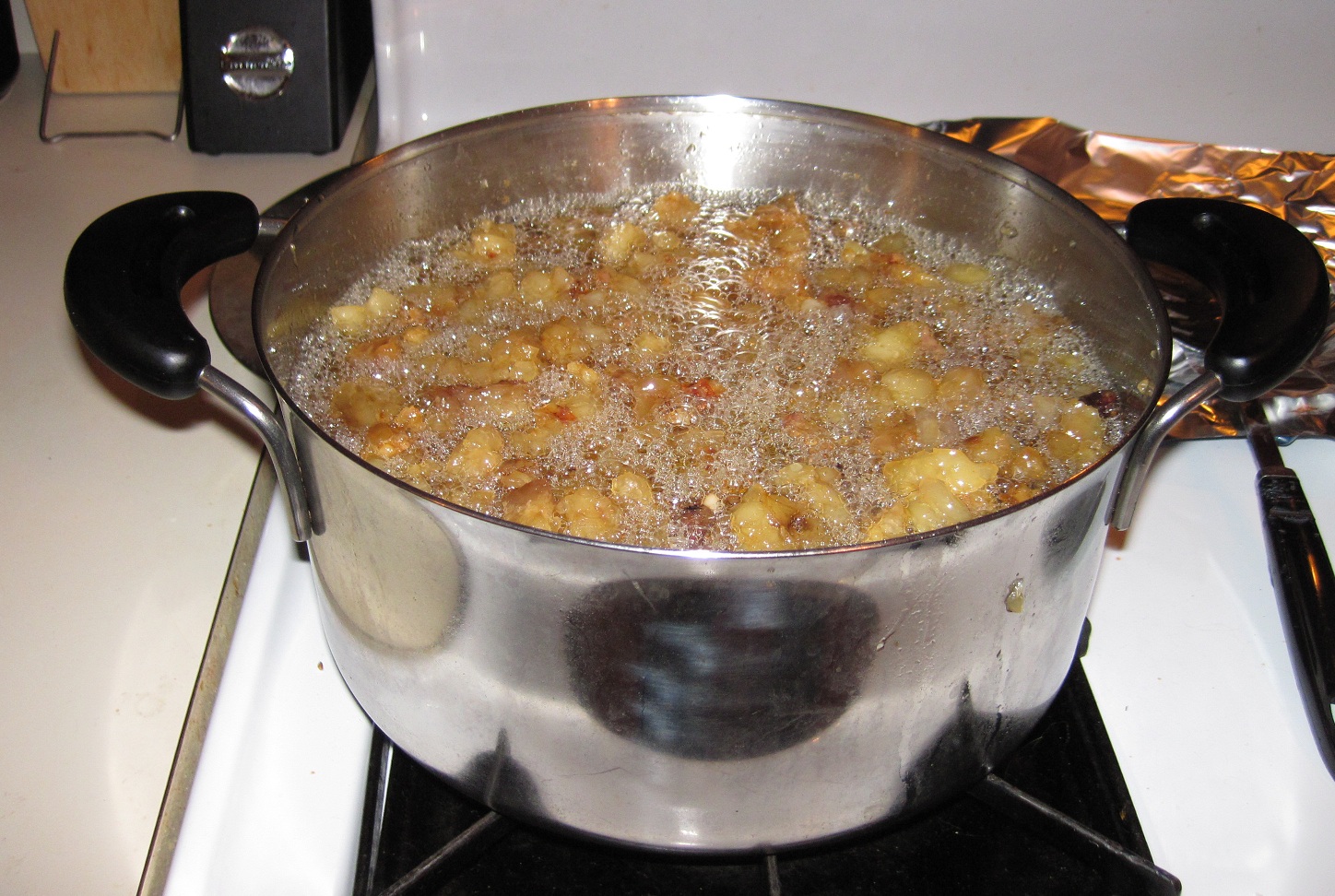
Place the pieces of fat in large stock pot and add just enough water to barely cover the bottom of the pot.  While not entirely necessary, starting out with the water in the pot will help prevent browning or burning of the fat.  This is not something that we really want to cook or impart any such flavor to.
Place this on the stove and turn on to medium low.  The water in the pot should just begin to simmer, and the fat should not fry.  If that fat starts frying you have the heat up too high.
Eventually, the fat will warm up and begin to soften.  Some of the actual fat itself will begin to melt out of the chunks, along with some water.  The liquid that begins to accumulate in the pot is a mixture of water and liquid fat.  Again, make sure that the heat is kept low enough so that you don't end up frying any of this.

After about an hour, perhaps longer, the chunks will have shrunk quite noticeably and the liquid will probably be bubbling away.  While the chunks of tissue will begin to get darker, ensure that the fat isn't frying by observing to see if there is any smoke.  The bubbles forming should be solely from the rapidly boiling water that is now escaping your pot.  This operation will take a couple of hours, so don't try to rush it by burning or frying your tallow.
Once the fat chunks have reduced in size considerably, it is time to begin straining out the liquid.  I recommend using a coffee filter, as cheesecloth really isn't fine enough to capture all of the little particles that are going to be suspended in the liquid.

 Eventually the pieces of fat will have given up all of the liquid that they can and will begin to get much darker.  When this point is reached, stop the rendering process and either drain and reserve the little tissue nuggets or discard them.  Some people like saving these to add to soups, but personally I have not had much luck with that.  Transfer all of the filtered liquid to a very clean pot and bring the temperature up to 250F.  If the liquid does not bubble, it is pure fat and the rendering process is over.  If the liquid bubbles, it is merely the remaining water boiling off, so hold the temperature fairly constant until the bubbling ceases.  Don't overheat the tallow or you may potentially burn it once all of the water has boiled off.
liquid tallow looks almost golden in color

Liquid tallow from grass fed cows will have a yellow to amber appearance.  The fat tends to accumulate vitamin E, CLA, and beta carotene that are lacking from grain-fed feedlot cattle.  It will be yellowish to slightly off-white once cooled.  Leaf lard (below) should be almost totally clear.  It will solidify to a snow-white solid once cooled.
liquid leaf lard, poured into jars and cooling down

Store a little of your rendered fat in a glass container in the refrigerator.  The remainder can be jarred and put into the freezer for long term storage, or you can even pour it into muffin tins and then freeze the little fat pucks in vacuum bags until you need them. 

Sunday, January 27, 2013

Out on the Farm

Sourcing Groceries

Happy cows are healthy cows. 
 Let me confess something here - shopping for food is absolutely my favorite kind of shopping.  I really enjoy finding good sources of healthy foods with which to make recipes from.  While I find lots of inspiration from books and the internet, and typically make my grocery lists quite organized in advance of heading out to the store, I also revel in wandering through the produce section of Whole Foods or Wegmans and choosing my upcoming menus based on what is fresh and available at the time.  Good ingredients  tend to come together naturally, while forcing a dish together with sub-par components typically yields sub-par results.

Grocery stores, such as the aforementioned, do in fact make up the majority of my food shopping trips, especially in the winter months.  I love visiting our local farm markets in the summer and fall, and given the option I would do all of my shopping there, but the reality of the situation is that in New Jersey the produce season is limited, and we don't grow coconuts or oats (which are basically dietary staples for us) that I'm aware of.  I like that Whole Foods sources at least some of their supplies from local producers, which also creates a different shopping experience depending on whether or not I happen to be down in Princeton of up in Ridgewood.  However, yesterday I made a trip for some really fantastic local food.

Vegetables might be out of season, but my nearest source of pasture raised grassfed beef is well stocked.  Going straight to the farm is such a fantastic experience and I recommend it to anyone who can (and if you do a little legwork, you will likely find a farm or six nearby).  Not only do you get to see how your food has been raised, but you can talk to the people who have raised it, and in my experience they are friendly and knowledgeable and very happy to talk shop.  I particularly like the fact that I know how my meat was treated before it reaches my table, which gives me peace of mind on the nutritional quality as well as the quality of life that the animal experienced.  You don't need to be a vegetarian to be proactive about animal welfare.  I eat animal products daily, and I treasure them as natural sources of high quality fats, protein, and vitamins/minerals.  Additionally, the money that I spent went directly to the farmer - I didn't have to pay a mark up to any middleman, and the farmer took home 100% of the retail sale.  

January isn't a high production month in the northeast for chickens that live outside freely, but the farmer and I took a walk to the coops to see if we could find a dozen or so eggs at my request.  We found only three, which she was kind enough to give to me for free, and I also got to take a look at the coops and laying boxes that they use on a small scale operation.  This was particularly neat, as Christa and I have been giving serious consideration to keeping a few chickens ourselves for egg laying once we have the space.


I picked up about 30lbs of mixed bones, some liver, a heart, and a little bit of ground beef there.  I hope that you stick around to see what I end up making out of all of it (some if will be delicious, I promise), and I encourage you to go out and meet the farmers in your area.  They are really your best source for fresh local food, and often times the healthiest and most humanely raised as well.